What does it take to turn 16 hectares of land into a new industrial development?

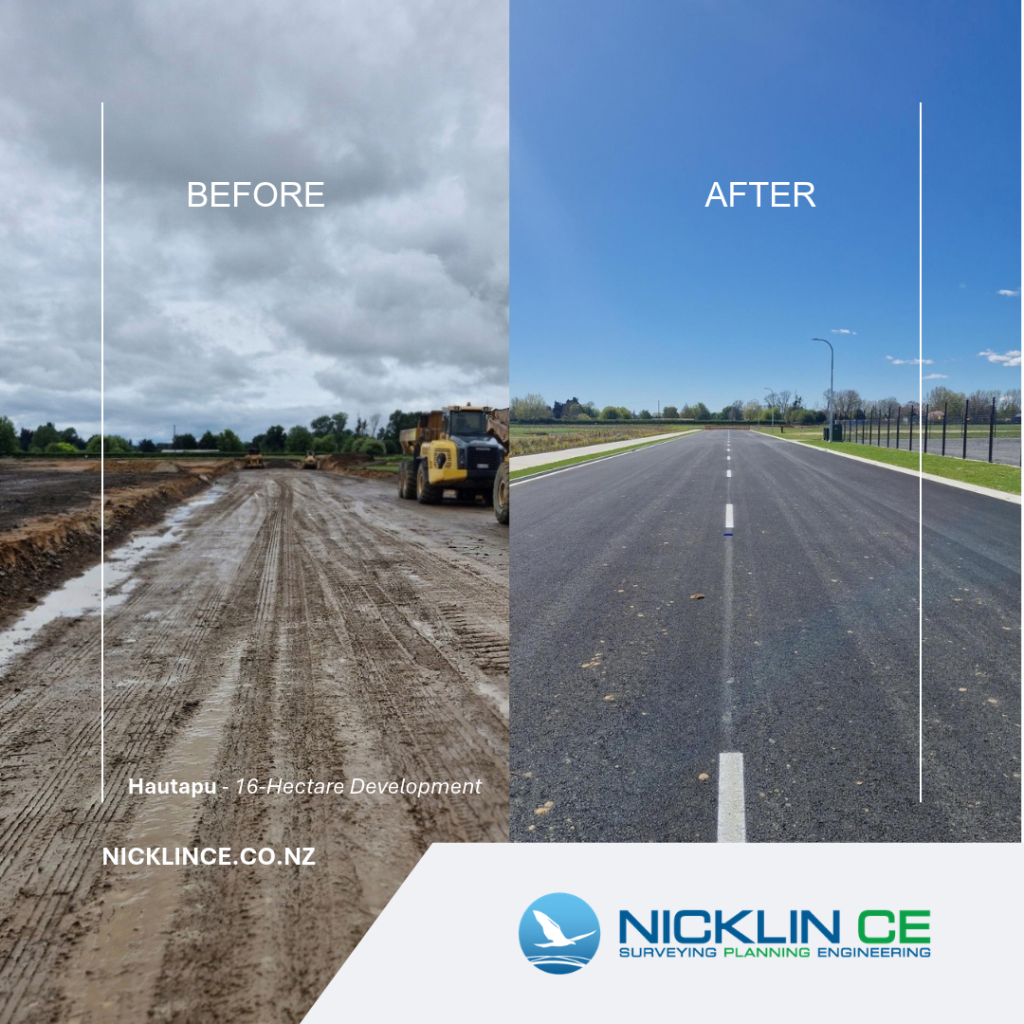
Hautapu Industrial Growth Cell 16-hectare development in Cambridge, showcasing Nicklin CE surveying, planning and engineering expertise throughout the land development process.

What does it take to turn 16 hectares of land into a new industrial development?

This project in Hautapu has involved a complete, end-to-end approach from our team, from the early design and planning stages through to consenting, construction supervision and the final stages of completion.

Located within the Hautapu Industrial Growth Cell, this significant 16 hectare development has required careful coordination across surveying, planning and engineering to bring the vision through to where it is today.

Our role has included designing the development, obtaining the necessary consents and supervising the works on site, working alongside the wider project team to keep things moving from plans to construction.

As the development approaches completion, we’re looking back at some of the work that has happened behind the scenes.

From detailed site work and technical design to construction set-out and onsite supervision, every stage plays an important part in creating an industrial development.

Projects of this scale don’t happen overnight, they often take years. They take expertise, coordination and plenty of work behind the scenes.

Check out the contrast, watch the video.

Rhys Kelly
Manager / Licensed Cadastral Surveyor | (BSurv), MS+SNZ
M: 027 317 7518  |  T: 07 827 4945  |  E: rhys.kelly@nicklince.co.nzwww.nicklince.co.nz
P: PO Box 754, Cambridge 3450
A: 6 Wilson Street, Cambridge, Waikato

Is your land development strategy working as hard as it could?

Senior Planner Gareth Moran discussing strategic land development opportunities and planning.

Senior Planner Gareth Moran discussing strategic land development opportunities and planning

Is your land development strategy working as hard as it could?

Here’s what one of our Senior Planners, Gareth Moran, has to say.

Land is one of the most valuable assets many people will ever own. But are you making the most of its potential?

For many property owners, development starts with a simple question: What else could I do with this land?

It might be subdividing a larger section, creating additional housing, developing a commercial or industrial opportunity, or investigating whether a property could support a use that sits outside its current zoning.

According to our Senior Planner Gareth Moran, these questions are becoming increasingly relevant as property owners look for ways to unlock value from land they already own.

“No more land is being created, so people are increasingly looking to maximise the productive value of the land they already own.” “The opportunity may be bigger than a subdivision.”

A two-lot subdivision might be the obvious starting point, but it is only one of many possibilities.

For some properties, the greatest opportunity may come from underutilised land, infill development or a change in land use. For others, the potential may lie in a more significant planning exercise, such as investigating an out-of-zone activity or pursuing a plan change.

These projects can carry greater upfront costs, longer timeframes and more risk, but they can also create substantially different outcomes where the underlying land opportunity is strong.

For example, moving land from a lower-value rural use towards an industrial or other higher-value use can potentially unlock significant value. The important question is not simply “Can I develop this?” but:

“What is the most appropriate and achievable use of this land, and what would it take to get there?”

That is where strategic planning becomes important.

Gareth believes the role of a planner has evolved considerably.

“The role of a planner is no longer that of a report writer; we are increasingly becoming project managers.”

For a client, that means good planning advice should extend beyond producing a document for council. It involves understanding the project, identifying risks and opportunities, communicating with the right people, coordinating the consent process and helping keep the development moving.

This becomes particularly important as projects become more complex.

“The earlier planning is considered, the more opportunity there is to shape the project around what is realistically achievable.”

There is no single development formula that works everywhere!

Auckland, Waikato and Bay of Plenty each have different land values, planning environments, development pressures and market expectations. Highly productive land is also an increasingly important consideration in parts of the Waikato, while different development pressures exist across the major urban areas.

Gareth’s experience reinforces the importance of understanding the property, the local planning environment and the intended market together.

That means a development strategy should not begin with a consent application. It should begin with understanding the opportunity.

With resource management reform continuing, the planning environment is evolving. New national direction is being introduced under the existing RMA while the Government progresses the replacement planning system, making it particularly important to base decisions on the rules that actually apply to your project today.

For landowners, developers and investors, this creates a reason to think strategically rather than simply react when a development idea arises.

Your property may already have an opportunity sitting within it.

It could be a straightforward subdivision. It could be infill development. It could be a change of land use. Or it could be a much larger opportunity that requires a more considered planning strategy.

Our planning team works alongside clients to identify opportunities, assess planning pathways and develop practical strategies, so before you decide what to build, it’s worth asking: “What could my land actually achieve?”

If you’re curious to learn more about Senior Planner Gareth Moran, click here. 

Nicklin CE - Surveying Planning Engineering team working on a land development project.


RMA Reform Update: What essential changes are coming for property owners and developers?

Nicklin CE – Surveying Planning Engineering provides an informative update on New Zealand’s RMA reforms and what the changes may mean for property owners and land development in the Waikato.

New Zealand’s planning system is undergoing its biggest overhaul in more than 30 years; the reforms are intended to simplify planning rules and reduce unnecessary consenting requirements when developing land. The claim comes from the New Zealand Government, specifically RMA Reform Minister Chris Bishop and Parliamentary Under-Secretary Simon Court.

On 30th of September 2026, the Planning Act and Natural Environment Act received Royal assent, beginning the gradual replacement of the Resource Management Act (RMA).

The current RMA will continue to apply during the transition, with the new planning system expected to become fully operational from 2030. However, some important changes will take effect earlier, from 30th of October 2026.

The RMA is being replaced by two separate Acts:

  • Planning Act: This primarily covers land use, subdivision and development.
  • Natural Environment Act: This primarily covers environmental matters, including freshwater, discharges and biodiversity.

Existing district and regional plans will progressively be replaced by a more coordinated planning framework, supported by long term regional spatial plans that identify future growth areas, infrastructure needs and development constraints.

While these changes are expected to create opportunities for some developments, the practical benefits will depend on the new national standards and planning rules introduced over the coming years.

So what does all this mean for your property or development?

The reforms are intended to simplify and standardise subdivision requirements, which could potentially create new development opportunities.

Subdivision will remain subject to planning rules and practical constraints, including infrastructure capacity, vehicle access, natural hazards and environmental requirements.

The existing RMA and district plan requirements will continue to apply during the transition, subject to the transitional amendments.

What about “Rezoning” ?

The current Government’s aim is to: “…make development more straightforward and reduce barriers to housing and land use.” As discussed in the NZ Herald article on the proposed overhaul of zoning rules, these changes could influence how land is zoned and what property owners may be able to develop in the future. Rezoning involves changing the designated use of land, such as from rural to residential, potentially creating new development opportunities, however, each property’s potential will still depend on the applicable planning rules, infrastructure, environmental constraints and approval requirements. Understanding all these factors can help support making better informed decisions about land use and property potential.

Importantly, from 1st of January 2028, councils will generally be unable to publicly notify new private plan changes unless a Ministerial exemption is granted.

If you are considering rezoning your property, we are suggesting that early action is now important, but simply lodging a private plan change request before this deadline will not guarantee that it can and will proceed.

What are some changes to consenting requirements?

From 30th of October 2026, amendments to the RMA will limit the matters councils can consider when assessing certain land use consent applications; these changes may simplify the assessment of some proposals and reduce consenting barriers; however, existing district plan rules will continue to apply, and the changes will not benefit every application.

What about infrastructure and development feasibility?

The changes to planning rules will not remove practical development constraints such as wastewater, stormwater, vehicle access or earthworks requirements.

New regional spatial plans will also identify areas for future growth and significant infrastructure needs over the next 30 years or longer.

Seeking advice from a qualified Planner will support understanding of these constraints early, and will remain essential when assessing development feasibility and costs.

So what about your “existing resource consents” … ? Now what?

Your existing resource consents will generally remain valid under the new system, with their conditions continuing to apply.

The legislation also provides for extensions to the expiry dates of certain consents. These extensions do not apply to every consent and do not necessarily extend the timeframe for giving effect to a consent.

We are recommending that landowners seek advice and review their existing consent conditions, expiry dates and lapse periods; support from one of our planners can help with this.

The transition period: what should you be doing now?

With the transition now fully underway, right now is a good time to review your property’s development potential, check those existing resource consent deadlines with your planner and consider whether any rezoning opportunities should be progressed.

For larger developments, understanding how future planning changes and infrastructure requirements could affect a project may make a significant difference to its feasibility, costs and timing, so it’s advised to seek professional advice from one of our planners as soon as you can.

How can Nicklin CE – Surveying Planning Engineering help you navigate the RMA Reform changes?

Nicklin CE – Surveying Planning Engineering has 30+ years of combined expertise in surveying, planning and engineering; this allows us to assess development opportunities from both a regulatory and practical perspective.

We assist property owners and developers to navigate these RMA Reform changes with professional insights from our qualified planners and cadastral surveyors, providing subdivision feasibility, resource consenting support, rezoning navigation, infrastructure assessments and development planning. You can also learn more here about our services across Surveying, Planning, and Engineering.

If you are considering subdividing? Purchasing development land? Rezoning a property or reviewing an existing consent? Our experienced team can help you understand how these RMA reforms may affect your specific development plans.

Reach out below to discuss your property or project with one of our teams across Waikato, Auckland and Bay of Plenty!

Nicklin CE – Surveying Planning Engineering | www.nicklince.co.nz | Waikato: (07) 827 4945

RPC – Surveying Planning Engineering | www.rpc.co.nz | Auckland: (09) 273 7505 | Bay of Plenty: (07) 575 4911

Article content

Disclaimer: Information is current as at 19th of October 2026. This article provides general information and is not legal advice, implementation dates and future national standards may be subject to change.*